
Holiday party games for large groups only work when everyone plays at once. Pick games that split into teams, finish in under ten minutes and need no rule longer than a sentence. That’s what separates a game that lands with 30 guests from one that falls flat.
Most holiday game lists assume eight people around a table. At 30, turn-taking becomes waiting.
What Makes a Holiday Party Game Work for a Large Group?
A large-group game works when most people are actively doing something, no matter how many guests show up. Four structural rules decide that, and they matter far more than which game you choose.
- Parallel beats sequential. If one person goes at a time, 30 guests means 29 people watching. Split into teams of five or six so six things happen at once.
- Rounds under ten minutes. Short rounds let latecomers join, let people step away for food and let you cut a game that isn’t landing without anyone feeling cheated.
- One-sentence rules. If explaining a game takes two minutes across a noisy room, half the party has already stopped listening. Demonstrate instead of explaining.
- No elimination. Elimination games shrink the number of players right when the energy should be peaking. Score points instead, so the person who loses round one still plays round four.
There’s a fifth rule that isn’t about the game at all: somebody has to run it. Pick one person to keep time, call rounds and announce scores. At 30 guests, a game with no host never gets started.
What Are Good Games for a Large Group Christmas Party?
The best large-group holiday games are team-based, scored and quick to reset. These seven need nothing more than a room, a few supplies and someone willing to hold a microphone.
- Reverse charades. The whole team acts while one person guesses. It fixes the biggest flaw in regular charades, where 29 people sit still while one person performs.
- Holiday trivia showdown. Table teams, written answers, five rounds of eight questions. Everyone plays every question, so it scales easily. Mix up the categories so the movie buffs and the music fans each get a round.
- Minute-to-win-it stations. Set up four or five one-minute challenges around the room and let teams rotate. With four stations running at once, a big group never forms a line.
- A holiday scavenger hunt. Ten to fifteen items or photo challenges, teams of five and a hard 20-minute clock. At a venue, photo challenges work better than object hunts because nothing goes missing.
- Name that tune. Play four seconds of a holiday song, and the first team to buzz in or raise a hand answers. It’s fast, loud and resets in seconds.
- An ugly sweater bracket. Instead of crowning a single winner, bracket it and let the room vote on each matchup. You get a running event instead of a two-minute announcement.
- Holiday bingo as an icebreaker. Use squares like “has worked here over five years” or “drove more than 30 minutes tonight.” It gets people talking to strangers in the first 20 minutes, which is the hardest part of any big party.
If a game needs more than one prop per team, it won’t hold up with 30 people. Keep the supply list short.
Which Holiday Party Games Work at a Venue Instead of an Office?
At a venue, the attractions are the games, which takes the setup and the running off your plate. These five formats turn a venue’s attractions into a scored competition for a group of 30 or more.
- A bowling bracket. Teams of five or six per lane, two games, cumulative pins. Everyone bowls the whole time, and the standings create the drama for you.
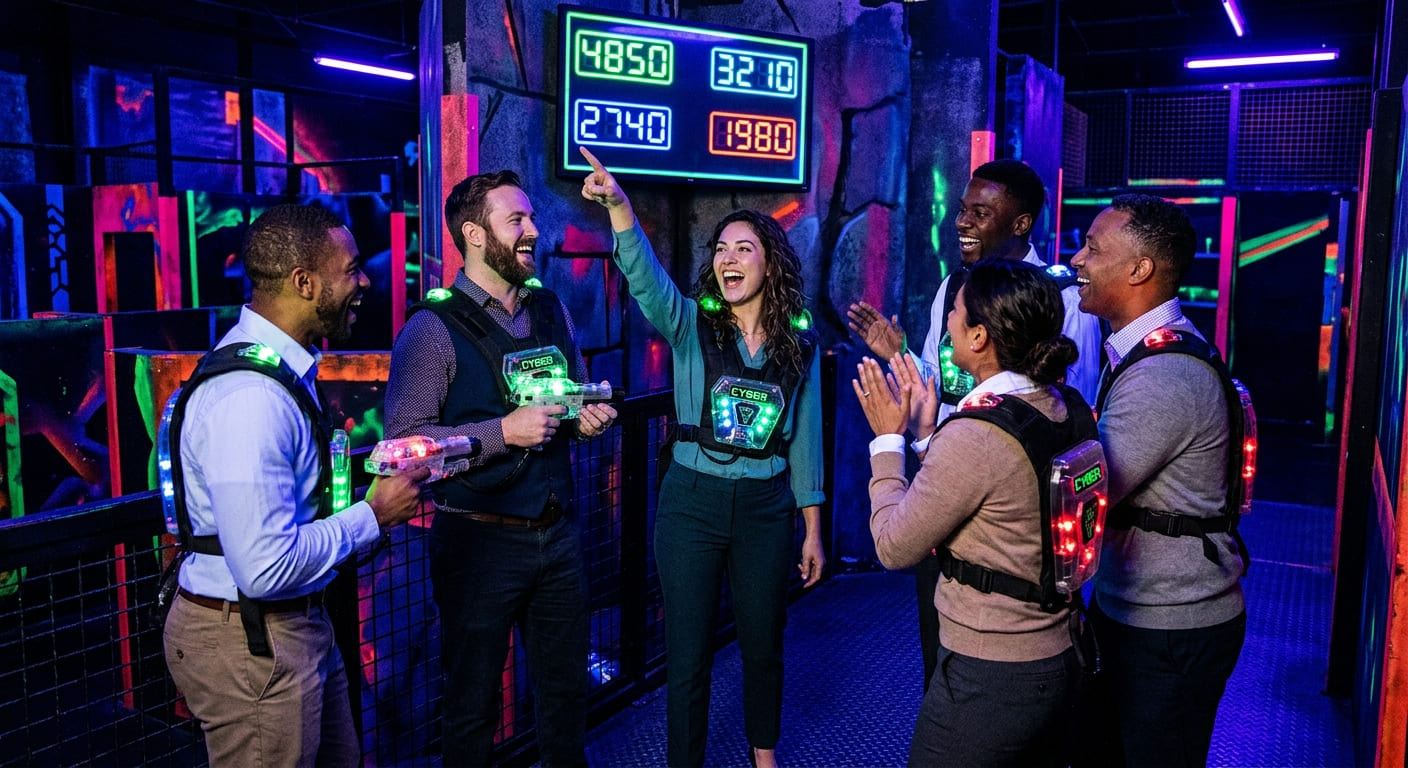
- A laser tag tournament. Short rounds with live scoring, run as heats, with the top two teams meeting in a final. Our laser tag arena is multi-level, so strategy matters more than athleticism and a mixed-ability group stays competitive.
- Gel blaster team missions. Water-based tactical play with objectives that reward communication over accuracy. It’s the rare team-building exercise people genuinely enjoy.
- An arcade high-score tournament. Pick three machines, give each guest one attempt on each and post the standings. It runs in the background while everything else happens.
- A cornhole or billiards ladder. A low-key option that runs all night for guests who’d rather talk than compete. Every big party needs one.
A venue also solves the rotation problem. Our company party and team-building packages are built for groups of 10 to 100 or more, with reserved sections and a coordinator who plans the rotation so 40 people aren’t all trying to bowl at the same moment. If your group is a mix of families and all ages rather than coworkers, our group outing packages run on the same structure.
How Do You Run a Gift Exchange Without Losing 45 Minutes?
Do the math before you commit. A white elephant exchange at 90 seconds per turn takes 45 minutes with 30 people, and that’s before a single steal. Steals push a 30-person exchange past an hour, and by then the last ten people are watching a game they mentally checked out of 40 minutes ago.
Three fixes, in order of how much time they save:
- Split into two or three circles. Three circles of ten run in parallel and finish in about 15 minutes. Nobody will miss the one big circle.
- Cap steals at two per gift. After the second steal, the gift is frozen. This one rule keeps the exchange from running long.
- Set and post the order in advance. Figuring out who goes next is where the dead air comes from.
If the exchange is the centerpiece of your party, run it early while attention is high. If it’s a tradition you’re honoring rather than the main event, run it in circles and get back to the games.
How Long Should Each Game Run at a 30-Person Party?
Plan a three-hour holiday party as six short blocks, not one long game session. This is the run-of-show we use for group events, and it works just as well for an office party in a rented room.
| Time | Block | What’s happening |
|---|---|---|
| 0:00–0:30 | Arrival and icebreaker | Food and drinks out, a holiday bingo card in every hand |
| 0:30–1:00 | First main game | The loudest, most physical option while energy is highest |
| 1:00–1:30 | Food | No structured game. People need a break to actually talk |
| 1:30–2:15 | Second main game or tournament final | The bracket you started earlier pays off here |
| 2:15–2:45 | Gift exchange or awards | Short, in circles, with a hard stop |
| 2:45–3:00 | Open play and goodbyes | Let it wind down instead of cutting it off |
Two things reliably go wrong: scheduling the gift exchange last, and scheduling nothing for the first half hour. Guests trickle in over about 25 minutes, and an unstructured start makes the whole party slower to warm up.
For options that aren’t holiday-specific, we have a longer list of indoor activities for large groups that works in any season.
Frequently Asked Questions
What party games work best for a group of 30 or more?
Team-based, scored games with rounds under ten minutes: reverse charades, trivia in table teams, minute-to-win-it stations, a scavenger hunt, or a bowling or laser tag bracket. Anything where one person acts and everyone else watches breaks down at this size.
How many games should a three-hour holiday party include?
Two main games, plus an icebreaker and one closing activity. That’s four game slots, with a food break and the gift exchange in between. Any more and the party starts to feel scheduled rather than fun, and you lose the unstructured time where people actually connect.
How far in advance should you book a venue for a holiday party?
Three to four weeks ahead for a December date, a Friday or a weekend. Outside the holiday rush, one to two weeks is usually enough for a group of 20 or more. December weekend rooms are the first to go.
Do you need prizes for holiday party games?
Not for every game, and not expensive ones. One prize per game, announced before the game starts, is enough to get people competing. The announcement matters more than the prize.
What holiday party games work for a mixed group of coworkers and families?
Choose games that don’t depend on shared background knowledge, so no inside jokes and no company trivia. Bowling brackets, laser tag, scavenger hunts and name that tune all work because a nine-year-old and a CFO can compete on equal footing.
How do you handle guests who do not want to play?
Give them a low-commitment option that runs all night. A cornhole or billiards ladder, or an arcade tournament they can join anytime, keeps non-players part of the party instead of sitting alone at a table.
What does a large-group holiday party cost per person?
At a venue, it’s usually quoted per guest. Our group packages run $14 to $28 per guest depending on the package and whether the date is peak or non-peak, with buffet options at $30 to $35 per guest. An 18% service charge applies to every group event, and packages start at a 10-guest minimum.
Planning a Holiday Party for 30 or More in Ogden?
Skinny Dogz is at 2261 Kiesel Avenue, Suite 1, in downtown Ogden, a short drive from Layton, Roy and Clearfield, and we’re open daily from 11 AM to 11 PM. Bowling, laser tag, gel blasters, an arcade, billiards and cornhole are all under one roof, so the games are already built and a coordinator plans the rotation for you. We host groups from 10 to more than 100, run bowling brackets and laser tag competitions on request, accommodate dietary needs and can arrange a full-venue buyout for larger parties.
Call or text the events team at (801) 627-4386 ext. 105, email events@skinnydogz.com, or send a quote request. Most inquiries get a reply within 24 hours.
Written by the Skinny Dogz Events Team, the crew that books, plans and runs group events at 2261 Kiesel Avenue in Ogden, Utah. The run-of-show and group logistics above come from how we actually schedule parties.